
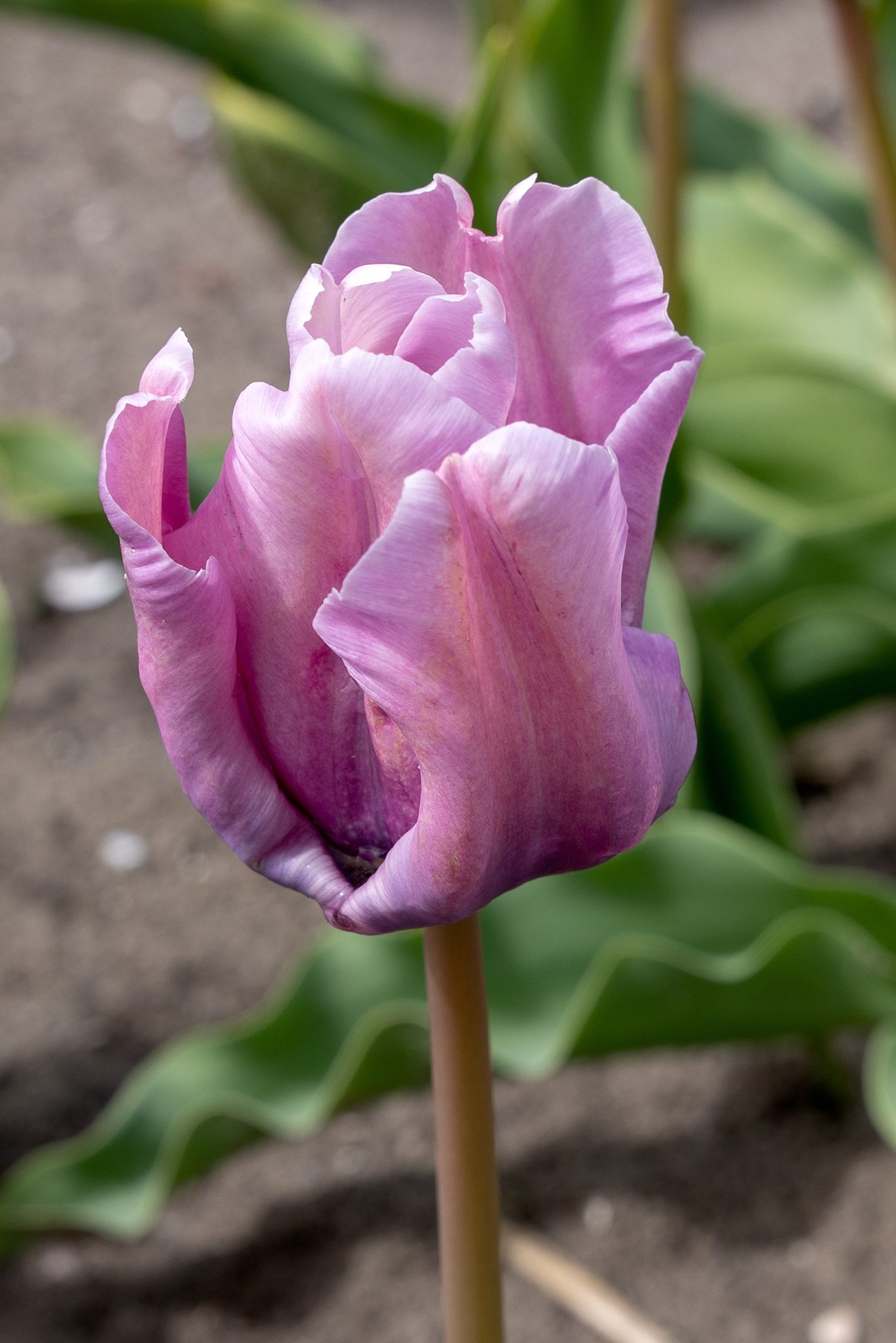
Tulipa Blue Parrot
Order Code: 132-24SEE DELIVERY UPDATES ON MAIN PAGE
from £6.00 to £23.75
Exotic, flamboyant and utterly unforgettable, Tulipa 'Blue Parrot' is one of the most dramatic Parrot Tulips, producing enormous, ruffled blooms in an extraordinary blend of smoky violet, lavender, plum and silvery-blue tones. Although no tulip is truly blue, this remarkable variety comes closer than most, with its cool, iridescent colouring creating a striking effect in the late spring garden.
The heavily feathered and deeply fringed petals twist and curl as the flowers mature, giving each bloom the appearance of an exotic tropical bird in flight. As the flowers open wider in sunshine, subtle shades of purple, mauve and steel-blue shimmer across the petals, ensuring that no two blooms appear exactly alike.
Flowering in May, 'Blue Parrot' reaches 45–55cm in height and makes an unforgettable feature in borders, patio containers and cutting gardens. Its unusual colouring pairs beautifully with deep purple tulips such as 'Queen of Night', elegant white varieties and ornamental Alliums, creating spectacular late spring displays.
The huge blooms and sculptural petals also make 'Blue Parrot' one of the finest tulips for dramatic floral arrangements, where each flower becomes a work of art in its own right.
A true conversation piece, Tulipa 'Blue Parrot' brings bold texture, remarkable colour and theatrical elegance to the spring garden.
Planting Instructions
<p>
<strong style="background-color: initial;">When to Plant:</strong>
</p>
<p>
Plant Tulip bulbs in <strong>autumn</strong>, ideally from <strong>October to December</strong>, once the soil has cooled. Planting later in autumn helps reduce the risk of tulip diseases and encourages healthy spring flowering.
</p>
<p>
<strong>Where to Plant:</strong><br>
Choose a position in <strong>full sun or partial shade</strong> with <strong>fertile, well-drained soil</strong>. 'Blue Parrot' is ideal for <strong>borders, large patio containers, cutting gardens and statement planting schemes</strong>. A sheltered position is beneficial, as the large blooms can catch strong winds.
</p>
<p>
<strong>How to Plant:</strong>
</p>
<ul>
<li><strong>Depth:</strong> Plant bulbs approximately <strong>15 cm (6 inches)</strong> deep.</li>
<li><strong>Spacing:</strong> Space bulbs <strong>10–15 cm (4–6 inches)</strong> apart.</li>
<li><strong>Soil Prep:</strong> Improve heavy soils with <strong>compost</strong> and, if necessary, add <strong>horticultural grit</strong> to improve drainage.</li>
</ul>
<p>
<strong>Watering:</strong><br>
Water thoroughly after planting to settle the soil. Once established, tulips generally only require watering during prolonged dry spells in spring.
</p>
<p>
<strong>Aftercare Tips:</strong>
</p>
<ul>
<li>Remove faded flowers once blooming has finished.</li>
<li>Allow the foliage to <strong>die back naturally</strong> for at least six weeks after flowering so the bulbs can replenish their energy for the following year.</li>
<li>Feed with a balanced fertiliser in early spring to encourage strong stems and large, vibrant blooms.</li>
</ul>
<p>
<strong>Top Tip:</strong><br>
Plant 'Blue Parrot' where its extraordinary ruffled flowers can be admired up close. Pair with elegant white tulips or dark varieties such as 'Queen of Night' for a spectacular late spring display and unforgettable cut flower arrangements.
</p>
Plant Details
Flowering Period:
May (depending on season and conditions)
Height:
18–22" (45–55cm) (approx.)
Position:
Full sun or partial shade
Hardy Perennial
Parrot Tulip
Recently Viewed

Avon Bulbs and Plants Ltd
Blows Lane
Sutterton
Boston
Lincs
PE20 2EJ
Tel: 07425 833906
Registered in the UK. 15837617
Copyright 2026 Avon Bulbs. All rights reserved