
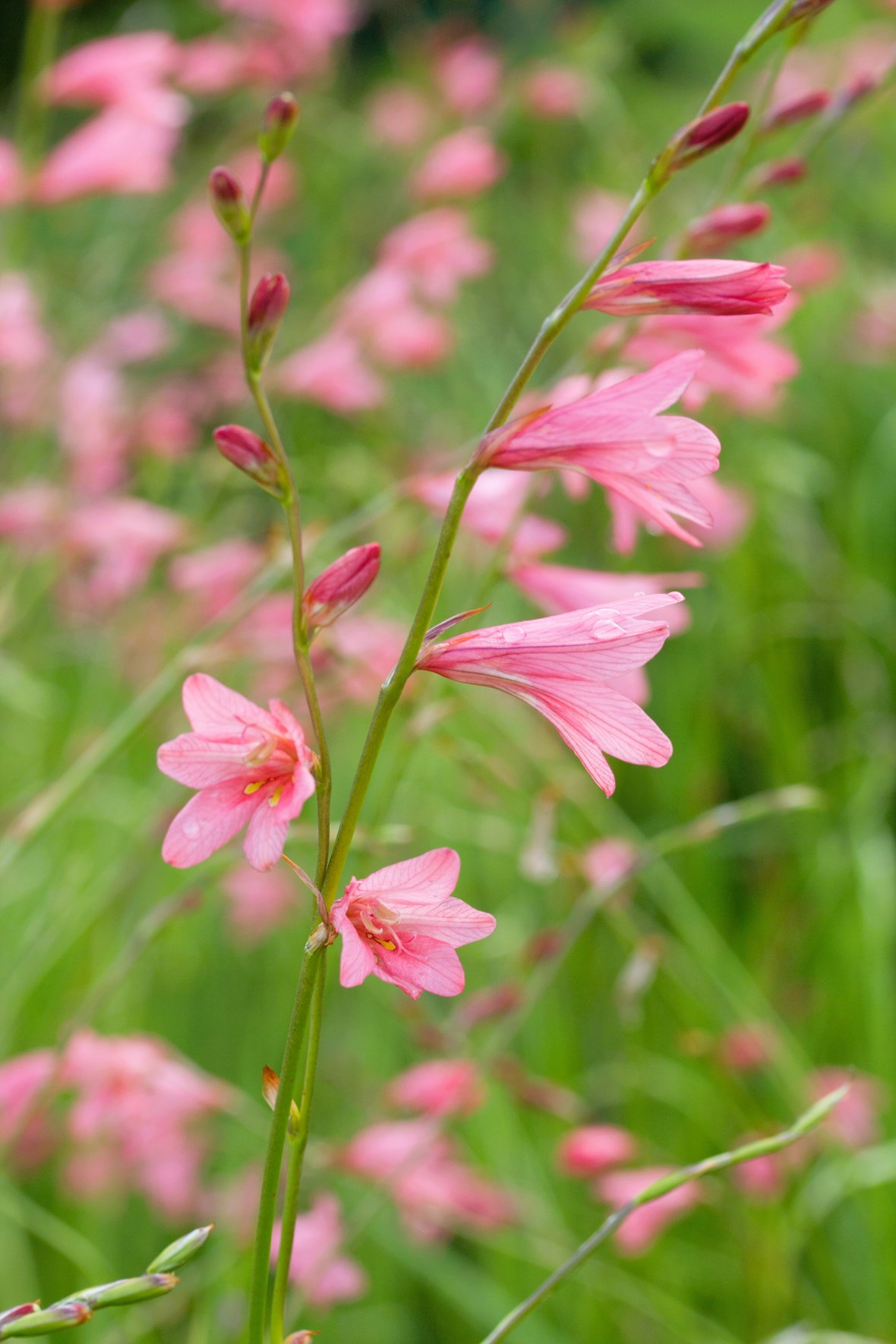
Tritonia x rosea (disticha rubrolucens)
Order Code: 15-11SEE DELIVERY UPDATES ON MAIN PAGE
from £6.00 to £10.00
An elegant and unusual summer-flowering bulb, Tritonia x rosea (disticha rubrolucens) produces graceful spikes of soft rosy-pink flowers that bring a light, airy charm to borders and containers.
Each slender stem carries a succession of delicate blooms, the petals gently flushed with warm pink tones and highlighted with deeper markings in the throat. The flowers open progressively along the stem, creating a long-lasting display that adds movement and colour to the garden through the warmer months.
Native to South Africa and closely related to Crocosmia and Freesia, Tritonia thrives in sunny, well-drained positions where it forms neat clumps of slender foliage topped with elegant flowering stems. Its refined appearance makes it especially suitable for mixed borders, gravel gardens, or patio containers, where its distinctive flowers can be appreciated up close.
Easy to grow and rewarding, Tritonia x rosea is also attractive to pollinating insects, making it a charming and useful addition to wildlife-friendly planting schemes.
Plant in groups for the best effect, where the graceful stems will create a natural and flowing display among other summer perennials.
Planting Instructions
When to Plant:
Plant Tritonia corms in spring once the risk of hard frost has passed and the soil begins to warm.
Where to Plant:
Choose a sunny, sheltered position with well-drained soil. Tritonia performs well in borders, gravel gardens and patio containers. In colder areas, planting in containers allows plants to be moved to a frost-free position over winter.
How to Plant:
- Depth: Plant corms about 5–7 cm (2–3 inches) deep.
- Spacing: Space corms about 10–15 cm (4–6 inches) apart.
- Soil Prep: Improve soil with garden compost. In heavier soils add grit or sharp sand to ensure good drainage.
Watering:
Water after planting and keep the soil lightly moist during active growth, particularly during dry spells. Avoid allowing the soil to become waterlogged.
Aftercare Tips:
- Allow foliage to die back naturally after flowering to help feed the corm for the following season.
- In colder areas, corms can be lifted and stored frost-free over winter.
- A mulch in autumn can help protect plants in milder regions.
Top Tip:
Plant Tritonia in small groups for the best display. The soft pink flowers look particularly beautiful mixed with ornamental grasses or silver-leaved plants.
Plant Details
Flowering Period
June – July
Height
45–60 cm
Spread
15–20 cm
Position
Full sun
Hardiness
Half hardy (H3) – best in well-drained soil or lifted in colder areas

Avon Bulbs and Plants Ltd
Blows Lane
Sutterton
Boston
Lincs
PE20 2EJ
Tel: 07425 833906
Registered in the UK. 15837617
Copyright 2026 Avon Bulbs. All rights reserved